Webbing in hangers

Webbing in hangers

The question we are going to answer in this post is:

Is it ok to rig using webbing directly into new bolt hangers?

I have rigged and used both inline and two-point anchors in a canyoning situation for years and never had any reason to be concerned. 

However, it was time to put some testing behind the practice.

Keep reading to find out the results, AND you get to download a detailed testing report at the end.

Introduction

The New Zealand Canyoning Association Bolting Code of Practice states that 15kN should be a minimum construction standard for temporary anchors.

Rigging for both inline anchors and 2-point fixed anchors use tubular webbing (16mm or 25mm) directly into hangers to share the load between 2 bolts. 

Therefore, this testing aims to ascertain if joining anchors in this way (with webbing into hangers) meets or exceeds 15kN.

Notes:

  • These temporary anchors are for lightweight canyoning first descents where you minimize the heavy hard wear you are carrying.
  • Even though multiple future canyoning groups could use the anchors, the anchors are considered temporary for canyoning as the webbing needs replacing regularly. 
  • If the canyon is going to get multiple descents in the future, upgrade the webbing to metal components as a permanent solution.
inline webbing bolt anchor
Inline webbing bolt anchor
2 point webbing bolt anchor
2-point webbing bolt anchor

Methods

General setup methods

  • As each test destroyed both webbing and hangers, they were new for every test.
  • Rings, carabiners and rapides, where they were undamaged, were reused for multiple tests.
  • No testing was done on used hangers, as carabiners or other attachments could create sharp edges.
  • All knots and bends had hand tension with all strands pulled tight.

Slow pull tests

The slow pull testing was in one location: Aspiring Safety, 1/6 Burdale Street, Riccarton, Christchurch, New Zealand. https://www.aspiring.co.nz/

  • Vertical testbed 1.6m Electronic Universal Testing Machine, Model WDW-100
  • Maximum Test Force 100kN, sample rate 60 per second 
  • Jinan Chuanbai Instrument Equipment Co Ltd
Inline webbing anchor testing

Anchor joining variations tested 

In both 16mm and 25mm tubular webbing

  • Loop with tape bend (control)
  • Inline: loop with tape bend + hanger (raw webbing)
  • Inline: loop with tape bend + hanger (tail padding)
  • 2 point fixed:  2 strands + overhand (control)
  • 2 point fixed: 2 strands + 2 hangers + overhand (raw webbing)
tape bend loop
Loop with tape bend (control)
Inline: loop with tape bend + hanger (raw webbing)
Inline loop with tape bend hanger (tail pad)
Inline: loop with tape bend + hanger (tail pad)
2 point fixed 2 strands overhand (control)
2 point fixed: 2 strands + overhand (control)
2 point fixed 2 strands 2 hangers overhand (raw webbing)
2 point fixed: 2 strands + 2 hangers + overhand (raw webbing)

Materials

CT hangers

  • Diameter: 10mm
  • Breaking strength: 25kN
  • Materials: 316L stainless steel
  • Standards: EN 795, EN 959, UIAA
  • Manufacturer: CT – www.climbingtechnology.com

Fixe hangers

  • Diameter: 10mm
  • Breaking strength: 25kN
  • Materials: 316L stainless steel
  • Standards: EN 795, EN 959, UIAA
  • Manufacturer: Fixe – www.fixeclimbing.com

Fixe rappel ring

  • Diameter: 10mm
  • Breaking strength: 35kN
  • Materials: 316L stainless steel
  • Standards: CE/UIAA Certified
  • Manufacturer: Fixe – www.fixeclimbing.com

Aspiring 16mm tubular webbing

  • Width: 16mm, Weight: 34 g/m
  • Breaking strength: 12.5kN
  • Materials: Nylon
  • Standards: Complies with EN 565
  • Brand: Aspiring – www.aspiring.co.nz

Aspiring 25mm tubular webbing

  • Width: 25mm, Weight: 51 g/m
  • Breaking strength: 21kN
  • Materials: Nylon
  • Standards: Certified EN 565
  • Brand: Aspiring – www.aspiring.co.nz

Results

Aspiring 16mm Tubular Webbing

Slow pull tests (100mm/minute)

Items tested

Avg. kN

# Tests

Comment

Loop 16mm webbing

17.71

3

Broke at the bend

Inline: loop webbing hanger

8.85

3

Cut webbing at the hanger

Inline: loop webbing hanger + tail padding

15.16

3

Cut webbing at the hanger, cut through both sling and tail padding.

2-point fixed: 2 strand

22.32

3

Broke at fixed overhand, top side, 1 strand, leg without bend

2-point fixed: 2 strands 2 hangers

17.96

3

Cut webbing at hanger, side without tape bend, other side almost cut through

Aspiring 25mm Tubular Webbing

Slow pull tests (100mm/minute)

Items tested

Avg. kN

# Tests

Comment

Loop 25mm webbing

31.13

3

Broke at the bend

Inline: loop webbing + hanger

15.42

3

Cut webbing at the hanger, hanger bent flat

Inline: loop webbing + hanger + tail padding

22.06

3

Cut sling at the hanger,  damage to the tail pad at the edges, hanger bent flat

2-point fixed: 2 strands

46.09

3

Broke the loops under overhand knot, broke leg without bend top side overhand knot, broke steel carabiner

2-point fixed: 2 strands 2 hangers

32.76

3

Cut webbingat the hanger, side without bend, slight damage to side with bend, hangers bent flat.

Analysis

Aspiring 16mm Tubular Webbing

Recommendations

When joining an inline anchor (ring and a hanger) with a piece of 16mm tubular webbing, it’s not suitable to use a raw sling against the hanger (av. 8kN); however, it is appropriate when a tail pad is in place (av. 15kN). 

Notes on the inline anchor:

  1. You could argue that the back anchor and webbing loop would only take 50% of the force if load sharing were equal for an inline anchor. 
  2. If this were the case, the back anchor sling would only need to take 7.5kN and therefore be suitable to use with raw webbing. 
  3. However, it can be difficult to rig the front and back bolt in a load sharing way. On the other hand, it’s simple to rig with a tail pad and achieve a full strength connection of 15kN, so do it.

When joining side by side anchors with a piece of 16mm tubular webbing directly into the hangers, it is over the minimum of 15kN (av. 17kN).

Aspiring 25mm Tubular Webbing

Recommendations

When joining an inline anchor (ring and a hanger) with a piece of 25mm tubular webbing, it is suitable to have a raw webbing against the hanger (av. 15kN) however is highly recommended to have a tail pad in place (av. 22kN).

When joining side by side anchors with 25mm tubular webbing directly into the hangers, it is over double the minimum of 15kN (av. 32kN).

Conclusions

In the context of use, the current combination of new 16mm or 25mm tubular webbing into new hangers (with tail pads for 16mm inline anchors) without any metal connections is suitable for temporary canyoning anchors. 

On average, over three tests, all but one series (inline 16mm raw webbing into a hanger) tested over 15kN, which is the standard in the New Zealand Canyoning Association Bolting Code of Practice.


Related Posts

webbing anchor header
Anchors

Is 16mm webbing strong enough for rescue?

The post tackles a practical question for backcountry rescue teams: is 16mm tubular webbing strong enough for anchor rigging, given the appeal of reducing weight in a rescue kit? To find out, the team ran a series of pull tests comparing different wrap-and-pull configurations — Wrap 1 Pull 1, Wrap 2 Pull 2, Wrap 2 Pull 1, and Wrap 3 Pull 2 — across several real-world surfaces: pins, carabiners, smooth rock, sharp rock, and edge-protected sharp rock. A baseline was first established using 25mm webbing before switching to the thinner 16mm webbing to see how it held up.
Read More »
Friction

Does a smaller radius have more friction?

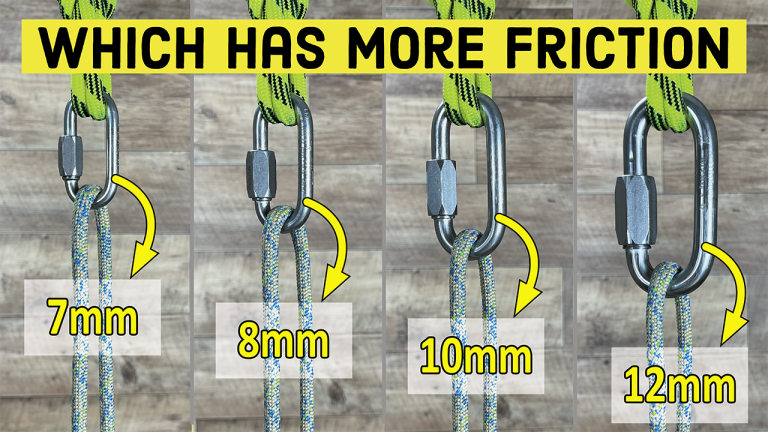
The post tackles a common assumption in rope work: that a smaller-radius device — a carabiner, mallion rapide, or belay device — produces more friction on a rope than a larger one, since the rope is thought to have more internal resistance as the radius decreases. To find out if this holds up, the team ran friction tests comparing stainless steel mallion rapides at 12mm, 10mm, 8mm, and 7mm, all using the same 8mm static rope. The results are checked against the Capstan Equation, which doesn’t include radius as a factor in the first place.

Read More »

Get the
top 5 rescue
checklist

Moments away

Want to be ready for rescue?

Get clarity, organised and practised