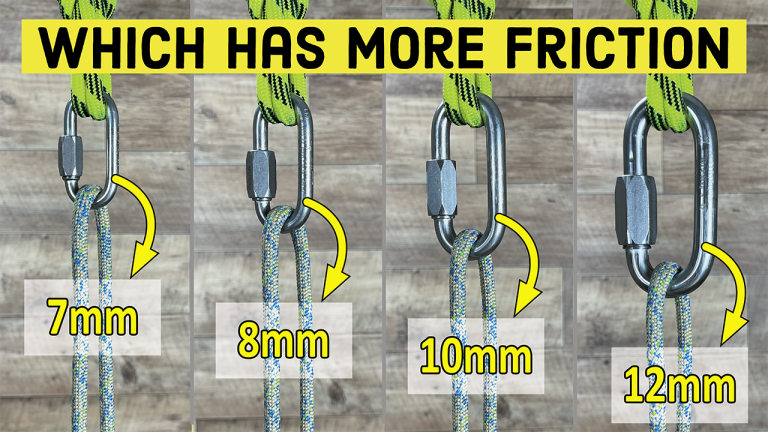
Which Has More Friction, One Carabiner or Two?

Which Has More Friction, One Carabiner Or Two?

With rope diameters trending smaller, there’s a common claim that two carabiners create more friction than one for a Munter hitch or a belay device like the Reverso. This post tests that claim across three stages: measuring the coefficient of friction directly, running slow-pull tests on different devices, and finally trying it out on a practical 10m abseil, using both round and frame-style carabiners.

What we are covering

1. Testing the coefficient of friction (CoF)

A rope sliding around one and two carabiners 

2. Slow pull testing

Testing devices and hitches

3. Practical application

10m abseil

Context

  • There is a trend toward smaller-diameter ropes. 
  • I have seen the claims that two carabiners create more friction for a Munter hitch and a climber’s belay device.
  • But is this statement true?
  • And if it is true, how much more friction does it create?
  • Are there any better options to increase friction?

One vs Two Carabiners

By two carabiners, I mean when they are clipped into the same point.

one carabiner reverso
two carabiner reverso

How much friction?

Practically, for abseiling and lowering, it’s about having the right amount of friction to allow smooth, controlled movement of the load (or yourself).

“Friction: Not too much, not too little, just right.”

1. Testing the coefficient of friction (CoF)

The theory – a rope around a cylinder

For a given load and a rope running around a cylinder (e.g. carabiner, device or hitch), the main things that influence friction are:

  • The coefficient of friction,
  • The contact angle (θ), and, to a lesser extent,
  • The pretension.

More information on the theory of a rope around a cylinder is in another post, which I have linked HERE.

➡️ “Does a SMALLER RADIUS DEVICE have more FRICTION? YES or NO?” https://youtu.be/IBIPpz3MF1U

Coefficient of Friction Diagram
Coefficient of Friction
Contact Angle Friction
Contact Angle
Pretension
Pretension

Coefficient of Friction – one or two?

The theory suggests that two carabiners have the same friction as one carabiner, since they have the same contact angle, provided the load, rope, and carabiners are identical.

Let me explain

  • For the single carabiner, the rope wraps around half
    a circle; therefore, the contact angle is 180 degrees. 
  • For the two carabiners, the rope wraps around 2x a quarter of a circle, 90 degrees each; therefore, the contact angle is also 180 degrees.
One carabiner or two contact angle

Testing the Coefficient of Friction

Let’s test the CoF to see if there is a difference between one and two carabiners, as well as frame and round carabiners.

  • The known load (L) is 0.1kN, which is the normal force (N), acting at 90 degrees to the carabiner, and 
  • The hand on the other side pulls down on the rope, and we measure the frictional force (F) with the load cell.
Coefficeint of Friction Testing Carabiner

Carabiner

We will also test two different types of carabiners to see if there is a difference in their coefficient of friction. The frame style is also called the T-beam construction

The carabiners tested are:

  • CT Warlock HMS 23kN 56g 104 x 70mm
  • CT Snappy HMS 23kN 86g 112 x 73mm
CT Warlock Carabiner
SNAPPY_SG_2C45900WBG
CT Snappy
Warlock Diameter Capilers
CT Warlock Diameter Caliper
CT Snappy Diameter Caliper

Rope

The rope used for testing is:

Sterling Canyon Lux 8mm

  • Type: Static rope 
  • Core: Spectra & Polypropylene
  • Sheath: Technora & Polyester
  • MBS: 24.2kN 
  • Weight: 41.2g/m 
  • Elongation @136kg: 3.9%
canyonlux

The Results

  • Average of 3 tests
  • F is the max. static friction
  • To work out the coefficient of friction (u), divide the frictional force (F) by the normal force (N) OR u=F/N
  • Efficiency is N/F as a percentage
Comparison of friction forces between one and two carabiners for climbing safety.

Question 1

Do two carabiners have a higher coefficient of friction than one?

Answer

YES–there is a small increase in friction with two carabiners compared to one (6%).

Results Analysis

While there is no increase in contact angle:

  • 2 x 90° contact angle increases the CoF a small amount: straight rope, around 90°, straight rope, around 90°, straight rope, compared to
  • 1 x 180° contact angle: straight rope, around 1800, to a straight rope
One carabiner or two contact angle

Question 2

Does a frame carabiner have a higher friction coefficient than a round carabiner?

Answer

 NO–there is no increase in friction with a frame carabiner compared to a round one. 

Results Analysis

Although the radius is smaller, that does not affect the friction. The only difference is the shape of the carabiners.

  • The frame carabiner (CT Warlock) is more oval, and 
  • The round carabiner (CT Snappy) is more round.
Frame vs Round shape

Conclusions – Coefficient of Friction

“Do two carabiners create more friction than one carabiner when we are abseiling or lowering?”

Based on the coefficient of friction test:

  • There is only a small increase in friction with one carabiner compared to two, and
  • No increase in friction with frame versus round carabiners.

2. Slow Pull Testing

Slow pull testing setup

  • Now, let’s test the max friction with the setup for a slow pull.
  • One hand – the right dominant hand – with a thin glove on, and the same person for all tests
  • Gripping firmly and letting the rope be pulled through the hand @ 100mm/min.
  • This relies on the tester maintaining a consistent grip on the rope for all tests.
Snappy Munter Slow Pull
Reverso Warlock Slow Pull

What we tested

Slow pull testing results – Munter

  • The Contact Angle x 180(degrees) is how many half-turns the rope makes around the device to create friction.
  • The Max Force kN is the Maximum Force the device can hold before the rope moves continuously through the single hand.
Slow Pull Test Data_Munter_1
  • Inserting an extra carabiner for a Munter has a minimal effect (0.1 kN).
  • A frame, compared to a round carabiner, has a minimal effect on friction for a Munter (0.3kN)
  • Overall, it is not worth the effort to install a second carabiner for added friction when using a Munter.
Slow Pull Test Data_Munter_2
  • An extra half wrap (Munter 1.5) provides moderate (0.7kN) additional
    friction & can be applied to a Munter while in use.
  • A frame, compared to a round carabiner, has a minimal effect on friction for a Munter 1.5 (0.3kN).
  • A Super Munter provides significantly more friction due to the additional wraps (over 2kN).
Max Force vs Contact angle Munter

If we graph the results where we compare the maximum Force on the Vertical Axis in kN to the Contact Angle of 180 degrees or half a turn on the horizontal axis we find that as the contact angle increases, so does the amount of force or friction for the Munter

Slow pull testing results – Reverseo

Slow Pull Test Data_Reverso_3
  • A single carabiner with a Reverso & 8mm rope has hardly enough friction.
  • Using two carabiners (of either type) for a thin rope provides some additional friction (0.5kN). The contact angle increases when using two carabiners, as they push the rope outward.
  • A frame, compared to a round carabiner, has a minimal effect on friction for a Reverso (0.1 kN).
Slow Pull Test Data_Reverso_4
  • For a Reverso, having the two carabiners split apart, with one used as a redirect, provides moderately more friction (0.6 kN)
    than when both carabiners are clipped into the
    same point.
  • A Reverso with the rope rigged through both holes provides significantly more friction due to the additional wraps.
Max Force vs Contact angle Reverso

Once again, as with the Munter, we find that as the contact angle increases, so does the amount of force or friction for the Reverso

Conclusions – Slow Pull Tests

“Do two carabiners create more friction than one carabiner when we are abseiling or lowering?”

  • Based on the slow pull test, there is only a small increase in friction with one carabiner compared to two, and slight increase in friction with frame versus round carabiners.
  • Based on the evidence, the best way to increase friction is to add an extra wrap around the carabiner, the device, or the rope.

3. Practical Abseil Testing

Practical abseil testing setup

  • Testing by abseiling 10m on a single rope 
  • Free hanging
  • 8mm Sterling Canyon Lux rope
  • With both one and two hands

How did it feel in comparison?

Subjective assessment of how it felt when abseiling

  1. HARD = It was hard to control, had to use close to maximum grip
  2. GOOD = Could control the speed without too much trouble
  3. EASY = Two fingers could hold the brake rope; however, it was still smooth
  4. TOO MUCH = Lots of friction, meaning the abseil 
    was jerky

Abseil 10m testing results – Munter

Abseiling 10m Munter_1
  • For a Munter, adding a second carabiner does not make a noticeable difference.
  • For a Munter, there is no noticeable difference between a round and a frame carabiner.
Abseiling 10m Munter_2
  • Using a Munter 1.5 is a good solution for applying more friction while abseiling on thin ropes.
  • For a Super Munter, use a round carabiner, as it’s
    smoother compared to a frame, which can be jerky.

Abseil 10m testing results – Reverso

Abseiling 10m Reverso_3
  • For a Reverso, using two carabiners (of either type) for a thin rope provides a noticeable increase in friction compared to using one carabiner.
  • For a Reverso, there is no noticeable difference between a round and a frame carabiner.
Abseiling 10m Reverso_4
  • For a Reverso, having the two carabiners split apart, with one used as a redirect, provides more friction and is much easier to control (compared to both carabiners clipped to the same point).
  • A Reverso with the rope rigged through both holes provides too much friction for an 8mm rope.

Conclusions for practical abseil testing

“Do two carabiners create more friction than one carabiner when we are abseiling or lowering?”

  • Using a second carabiner can increase friction with a Reverso belay device by a small amount, but not with a Munter.
  • Using a frame or a round carabiner did not make a noticeable difference in friction.
  • Based on the evidence and theory, the best way to increase
    friction is to take an extra wrap around a carabiner, the
    device or the rope.
  • Therefore, other rigging options showed better
    performance for increasing friction rather than adding a second
    carabiner, e.g. Munter 1.5 or a redirect for the Reverso

Practice

  • Practically, for abseiling and lowering, it is about having the right amount of friction to allow smooth movement of the load (or yourself) under control. 
  • Have a plan and understand how to increase or decrease friction.
  • Practice in a safe environment with the rope, load
    and conditions until you have your friction options
    dialled in.

Video

➡️  PART ONE — Testing the Coefficient of Friction

➡️  PART TWO — Slow Pull Testing

➡️ PART THREE — Practical Abseil Testing

For more detailed information: 

Rope Rescue & Rigging Field Guide (3rd edition)

for cave, canyon, alpine and rock

Provides easy-to-reference practical reminders on essential field techniques for teams and individuals training and responding to rope rescue incidents. 200+ pages, 250+ drawings, A6 size, waterproof paper

Disclaimer

SUMMARY: This post is not an instructional guide. Use at your own risk. We assume no responsibility or liability for any errors or omissions. Any testing undertaken was under controlled conditions with a limited set of equipment. The views, information, or opinions expressed in the post are solely those of the author. For the full disclaimer, click HERE

Related Posts

webbing anchor header
Anchors

Is 16mm webbing strong enough for rescue?

The post tackles a practical question for backcountry rescue teams: is 16mm tubular webbing strong enough for anchor rigging, given the appeal of reducing weight in a rescue kit? To find out, the team ran a series of pull tests comparing different wrap-and-pull configurations — Wrap 1 Pull 1, Wrap 2 Pull 2, Wrap 2 Pull 1, and Wrap 3 Pull 2 — across several real-world surfaces: pins, carabiners, smooth rock, sharp rock, and edge-protected sharp rock. A baseline was first established using 25mm webbing before switching to the thinner 16mm webbing to see how it held up.
Read More »
Friction

Does a smaller radius have more friction?

The post tackles a common assumption in rope work: that a smaller-radius device — a carabiner, mallion rapide, or belay device — produces more friction on a rope than a larger one, since the rope is thought to have more internal resistance as the radius decreases. To find out if this holds up, the team ran friction tests comparing stainless steel mallion rapides at 12mm, 10mm, 8mm, and 7mm, all using the same 8mm static rope. The results are checked against the Capstan Equation, which doesn’t include radius as a factor in the first place.

Read More »

Get the
top 5 rescue
checklist

Moments away

Want to be ready for rescue?

Get clarity, organised and practised