Rigging Myths and other things rope

Rigging Myths and other things rope

NZOIA Symposium Paper, Tihoi, October, 2014, by Grant Prattley.

At the NZOIA conference at Tihoi we had a bunch of people out for half a day breaking and load testing various components in rope systems and maybe a few myths along the way. Back in the classroom, we discussed the theoretical concept of vectors. The idea was to open up the thinking and start analysing what you have.

Testing 

We set up a load cell and then various participants produced all sorts of old and new bits of gear to test. We broke the gear with a 9:1 pulley system with around 4-6 people pulling. Using a pulley system allows you to feel the real force required to break the gear. The testing was limited to software as hardware tends to have a mind of it own once broken. The serious business of breaking stuff and then the final act of breaking the load cell (accidentally).

What we tested:

  • 8mm nylon accessory cord – Clove Hitch, Figure 8 on the bight.
  • 6mm accessory cord on 10mm Donaghys Polyester – Prusik (Classic), Klemheist, French.
  • 11mm nylon static rope – 6mm Accessory Cord VT Prusik (Canyoning), Croll (mechanical ascender).
  • 10mm Beal Dynamic – Clove Hitch
  • 11mm nylon static rope – Italian hitch holding power
  • 20mm Webbing – Girth hitch onto a carabiner, Tape bend.

Related Posts

webbing anchor header
Anchors

Is 16mm webbing strong enough for rescue?

The post tackles a practical question for backcountry rescue teams: is 16mm tubular webbing strong enough for anchor rigging, given the appeal of reducing weight in a rescue kit? To find out, the team ran a series of pull tests comparing different wrap-and-pull configurations — Wrap 1 Pull 1, Wrap 2 Pull 2, Wrap 2 Pull 1, and Wrap 3 Pull 2 — across several real-world surfaces: pins, carabiners, smooth rock, sharp rock, and edge-protected sharp rock. A baseline was first established using 25mm webbing before switching to the thinner 16mm webbing to see how it held up.

Read More »
Friction

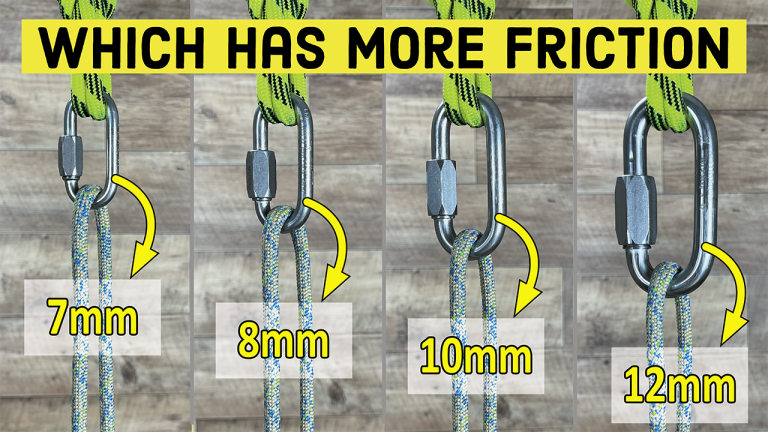
Does a smaller radius have more friction?

The post tackles a common assumption in rope work: that a smaller-radius device — a carabiner, mallion rapide, or belay device — produces more friction on a rope than a larger one, since the rope is thought to have more internal resistance as the radius decreases. To find out if this holds up, the team ran friction tests comparing stainless steel mallion rapides at 12mm, 10mm, 8mm, and 7mm, all using the same 8mm static rope. The results are checked against the Capstan Equation, which doesn’t include radius as a factor in the first place.

Read More »

Get the
top 5 rescue
checklist

Moments away

Want to be ready for rescue?

Get clarity, organised and practised