What’s in this post?
We undertook testing to confirm the 2:1 Load Release Hitch rescue setup and see if it was suitable for both single and two-person loads as far as maximum force (tied off with a Munter Mule Overhand) and had enough friction for lowering during load transfer.
The Load Release Hitch problem
A Load Release Hitch, built with two HMS (or pear-shaped) carabiners and cord (10m of 8mm), is, for example, used for a directional pulley and passing bends.
You can use it as a tool to create a bypass and transfer load in a rescue system.
The Problem
In the past, we have used a 3:1 CD (Change of Direction) Load Release Hitch. The problem with this setup was:
- There was too much friction, meaning it was hard to lower
- Minimal extension (around 2.5m) when used with a 10m x 8mm cordalette
- As a result, it didn’t work very well.
The Solution
So we changed. We tried using the 2:1 CD Load Release Hitch for rigging in cave rescue as it:
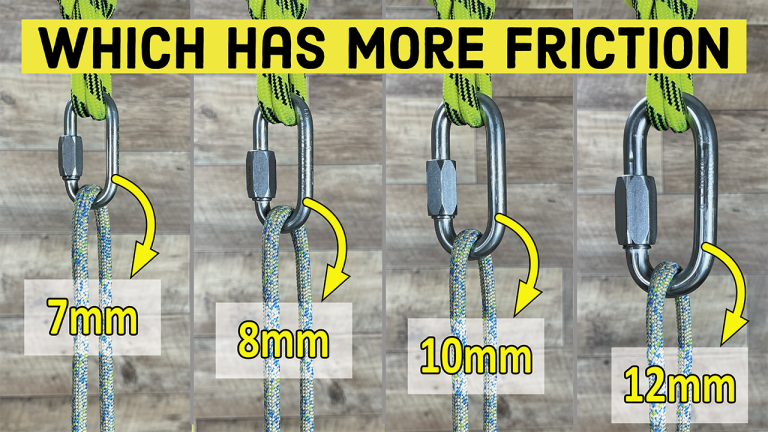
- Had enough friction with an 8mm cord for a single-person load
- It gave much more extension (4m) for a 10m x 8mm cordalette (compared to the 3:1CD
- As a result, it was easy to adjust, and it worked well
We undertook testing to confirm this rescue setup and see if it was suitable for both single and two-person loads as far as maximum force (tied off with a Munter Mule Overhand) and had enough friction for lowering during load transfer.
At the end there is a bonus testing report to download and 2 videos. One video is on the testing. The other video is on building, tying-off and lowering the 2:1 Load Release Hitch
Tying and Using
Methods and Materials
Test Method
- Slow pull tests on a 50kN vertical testbed (60Hz) was used at Aspiring Safety, 1/6 Burdale Street, Riccarton, Christchurch, New Zealand. https://www.aspiring.co.nz.
- New accessory cord was used for the testing.
- 8mm cord tails were 5cm.
- All knots, hitches and tieoffs had hand tension. All strands were pulled to get them tight and compact.
- The testing speed was 100mm/minute.
- The 8mm cords were tested between 12mm steel carabiners.
Materials used
PMI 8mm accessory cord
- Diameter: 8mm
- Breaking strength: 14.3kN
- Materials: Core/Sheath – Nylon/Nylon
- Standards: EN 564 Accessory Cord
- Weight: 42g/m
- Manufacturer: PMI – www.pmirope.com
Testing Results
PMI 8mm 2:1 Load Release Hitch + Tie-off
Testing
- Test: 2:1 Load Release Hitch tie off with Munter Mule Overhand
- Type: Slow pull tests 100mm/minute
- Average Max Force (3 tests): 22.31kN
- Comments: Cord broke at figure-8 on a bight top end (2) & broke at the 12mm carabiner lower end (1)
PMI 8mm 2:1 Load Release Hitch + Friction
Testing
- Test: One hand holding the cord at the end of the 2:1 Load Release Hitch
- Type: Slow pull tests 100mm/minute
- Max force (1 test): 3.89kN
- Comments: Cord slipped through bare hand
Testing
- Test: Two hands holding the cord at the end of the 2:1 Load Release Hitch
- Type: Slow pull tests 100mm/minute
- Max force (1 test): 6.51kN
- Comments: Cord slipped through bare hands
Conclusions
The 2:1 Load Release Hitch + Munter + Mule Overhand in 8mm accessory cord is suitable and recommended for rigging in rescue:
- When tied off during slow pull, it breaks at over 20kN
- Has suitable friction for lowering a two-person load with over 3kN with one hand holding, and over 6kN with two hands holding, and
- Is practical to use with a 10m of 8mm cord giving adequate extension.
Testing Report and Videos
Testing Report
Testing and Tying Videos
Click the image below to access the testing video.
Click the image below to access the building, tying-off and lowering video.
Disclaimer
SUMMARY: This post is not an instructional guide. Use at your own risk. We assume no responsibility or liability for any errors or omissions. Testing was under controlled conditions with a limited set of equipment. The views, information, or opinions expressed in the post are solely those of the author.
For the full disclaimer click HERE