Time to meat human anchors

Time to meat Human Anchors

A temporary human (meat) anchor is used in sports such as caving and canyoning, to get the first or all but the last person down, using a person (or people) that is suitably positioned in a stance where they can use the friction of rope on the rock, their own mass and their legs to provide sufficient anchoring.

This technique needs to be well managed and can provide safe and efficient travel through terrain that could otherwise take a long time if you were setting up anchors and rigging. This style of temporary anchor is fast to set up and take down.

Key elements

  1. Find a good stance with a sitting/feet position behind a rock or wedged in a crack.
  2. Use one or multiple people clipped into the system appropriate to the load with sufficient margin e.g. consider weight difference between the meat anchor and the abseiler/load.
  3. Have the rope running over a smooth rock for friction, taking some of the load
  4. Gentle abseiling and keeping close to the rock when taking off is a good idea.
  5. Use a releasable system, so that the person/load can be lowered for any reason e.g. an abseil device
  6. Have a plan and pre-arranged communication for coming off the rope
Meat Anchor Pegleg Creek
Meat Anchor Pegleg Creek (photo James Abbott)

What is it used for?

  • Downclimbs that can be protected from the bottom (spotting) for the last person down.
  • Provide a rope for less experienced or confident people to downclimb (or to abseil the downclimb).
  • To get the first person down to check out a pool for a potential slide or jump in a canyon. Everyone else can choose to slide or jump if the pool checks out OK.
  • Provide a quick application rescue anchor suitable in certain circumstances (more on this later)
Human anchor short abseil

Communication is key

One of the main things to manage is making sure the abseiler is at the bottom before disengaging the human meat anchor. The weight coming off the rope which could mean the abseiler has paused on a ledge.

  • Have a communication plan before the abseiler gets on the rope or the rope is loaded.
  • Communication could include the use of hand signals, whistle signals, or another canyoner positioned relaying at the edge.
  • Make sure you have a positive confirmation that the abseiler is down.

How much load?

As part of a canyon rescue training day (with Tasman Search and Rescue and the New Zealand Canyoning Association) we decided to test how much a meat anchor could hold. First, we tried in a not so good example of a meat anchor to look at the minimum rating and then looked at a better example where a person was well placed behind a rock with friction and a good bucket seat.

A not so good meat anchor

Sitting on the ground

  • 1 Person – 0.7kN (moving at around 0.5kN)
  • 2 Person – 0.8kN
  • 3 Person – 1.3kN (moving at around 1kN)
Not so good meat anchor

A much better meat anchor

Wedged behind a rock with friction on the rope over a rock

  • 1 Person – 2.6kN (moving at around 2kN)
A much better meat anchor

What about rescue?

First thing is to consider the loading and where you are going to use this style of an anchor. Ask what is the consequence if the meat anchor needs to be released i.e. there is too much load? Come up with a contingency plan if this happens.

The human (meat) anchor is a good tool for intermediate terrain where a patient or a stretcher needs a rope for a short slope or pitch. Something that you would usually downclimb, slide or jump.

The other thing it is useful for is a bottom anchor for a simple tracking line. Multiple people are clipped into the bottom of the tracking rope. The patient or stretcher is kept just off the terrain.

Human anchor multi-point
Human anchor tracking line

Summary

I know some of this may be quite a challenging read for those who believe you have to have a fixed anchor in all the time. The first time you put a human meat anchor in place and someone uses it to abseil off can be challenging for the head. Then, as you gain more experience, you realise you often don’t feel a lot of load coming onto your harness.

When you are starting, I strongly recommend using this in a safe location (e.g. a deep pool underneath you, or a separate belay) with an experienced person to guide you through.

Remember: this technique needs to be well managed and can provide safe and efficient travel through terrain that could otherwise take a long time if you were setting up anchors and rigging.

From the team at Over the Edge Rescue

Grant

Order now – Rope rescue and rigging field guide 3rd ed.

We are expecting the 3rd edition of the Rope rescue and rigging field guide back from the printer from the week of 31 August 2020.

Preorder and we will send it as soon as we have it.

Check it out here: 

Related Posts

webbing anchor header
Anchors

Is 16mm webbing strong enough for rescue?

The post tackles a practical question for backcountry rescue teams: is 16mm tubular webbing strong enough for anchor rigging, given the appeal of reducing weight in a rescue kit? To find out, the team ran a series of pull tests comparing different wrap-and-pull configurations — Wrap 1 Pull 1, Wrap 2 Pull 2, Wrap 2 Pull 1, and Wrap 3 Pull 2 — across several real-world surfaces: pins, carabiners, smooth rock, sharp rock, and edge-protected sharp rock. A baseline was first established using 25mm webbing before switching to the thinner 16mm webbing to see how it held up.
Read More »
Friction

Does a smaller radius have more friction?

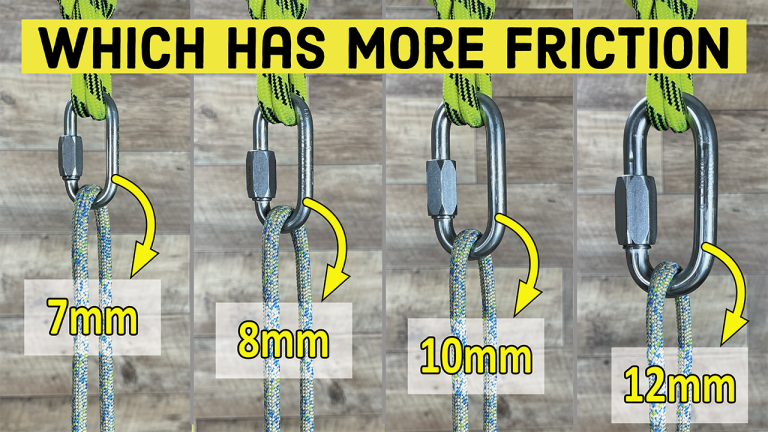
The post tackles a common assumption in rope work: that a smaller-radius device — a carabiner, mallion rapide, or belay device — produces more friction on a rope than a larger one, since the rope is thought to have more internal resistance as the radius decreases. To find out if this holds up, the team ran friction tests comparing stainless steel mallion rapides at 12mm, 10mm, 8mm, and 7mm, all using the same 8mm static rope. The results are checked against the Capstan Equation, which doesn’t include radius as a factor in the first place.

Read More »
Which has more friction One Carabiner or Two
Friction

Which Has More Friction, One Carabiner or Two?

With rope diameters trending smaller, there’s a common claim that two carabiners create more friction than one for a Munter hitch or a belay device like the Reverso. This post tests that claim across three stages: measuring the coefficient of friction directly, running slow-pull tests on different devices, and finally trying it out on a practical 10m abseil, using both round and frame-style carabiners.

Read More »

Get the
top 5 rescue
checklist

Moments away

Want to be ready for rescue?

Get clarity, organised and practised