Let’s lighten the load

Let’s lighten the load

After a particularly arduous 24hrs underground and 1000m of hauling on a deep cave SAREX(Search And Rescue EXercise) we started our journey towards asking the right questions about lightweight rope rescue.

Could we lighten up the backcountry rope rescue gear we use while keeping acceptable safety margins?

We knew we had to start with a change in philosophy. The realisation that changed my thinking was that every rope rescue I had done was a single-person load. After hundreds of operations and 27 years of experience, the only time I have rescued a two-person load was in training.

For lightweight rope rescue, one of the first things we considered was a smaller diameter rope. Two immediate questions arose: would we be able to find equipment to work with a smaller diameter and would that have the performance we needed?

We teamed up with the Speleological Society (NZSS), Cave SAR and Land SAR in New Zealand to undertake performance testing on 10mm rope for lightweight rope rescue. The trials included 100kg and 200kg drop tests on belay devices (7mm Edelrid Tandem Prusiks, Petzl Grigri+, and Edelrid Eddy) and slow pull tests on rope grabs (7mm Edelrid Prusiks and Petzl Basic).

To get the results of the testing enter your first name and email address below, and I’ll send you the article ‘Let’s lighten the load.’

Note: there is now an updated version of the testing completed over 2020/21: Let’s lighten the load: update. Check it out HERE.

Grant at Over The Edge Rescue.

Related Posts

webbing anchor header
Anchors

Is 16mm webbing strong enough for rescue?

The post tackles a practical question for backcountry rescue teams: is 16mm tubular webbing strong enough for anchor rigging, given the appeal of reducing weight in a rescue kit? To find out, the team ran a series of pull tests comparing different wrap-and-pull configurations — Wrap 1 Pull 1, Wrap 2 Pull 2, Wrap 2 Pull 1, and Wrap 3 Pull 2 — across several real-world surfaces: pins, carabiners, smooth rock, sharp rock, and edge-protected sharp rock. A baseline was first established using 25mm webbing before switching to the thinner 16mm webbing to see how it held up.

Read More »
Friction

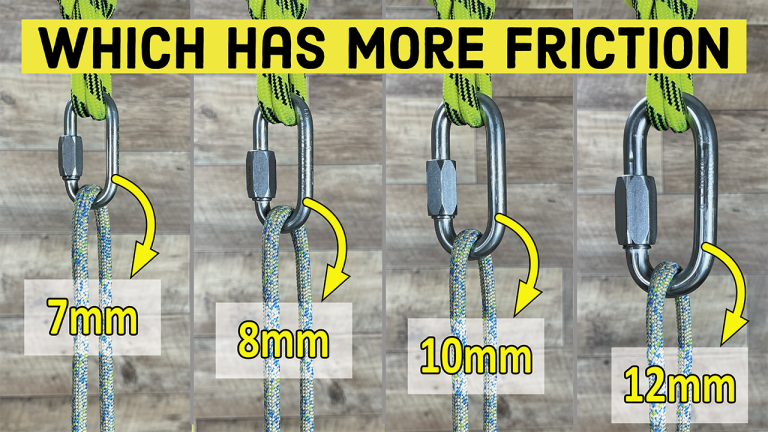
Does a smaller radius have more friction?

The post tackles a common assumption in rope work: that a smaller-radius device — a carabiner, mallion rapide, or belay device — produces more friction on a rope than a larger one, since the rope is thought to have more internal resistance as the radius decreases. To find out if this holds up, the team ran friction tests comparing stainless steel mallion rapides at 12mm, 10mm, 8mm, and 7mm, all using the same 8mm static rope. The results are checked against the Capstan Equation, which doesn’t include radius as a factor in the first place.

Read More »
Which has more friction One Carabiner or Two
Friction

Which Has More Friction, One Carabiner or Two?

With rope diameters trending smaller, there’s a common claim that two carabiners create more friction than one for a Munter hitch or a belay device like the Reverso. This post tests that claim across three stages: measuring the coefficient of friction directly, running slow-pull tests on different devices, and finally trying it out on a practical 10m abseil, using both round and frame-style carabiners.

Read More »

Get the
top 5 rescue
checklist

Moments away

Want to be ready for rescue?

Get clarity, organised and practised